Document translation and conversion
Translate, convert and understand any PDF.
Formulas stay formulas. Tables stay tables. The layout stays where the author put it. Upload a paper, a scanned textbook or a 300-page report and get it back in your language, or as Markdown, LaTeX, Word or Typst, then ask it questions. The free plan needs no card.
- 11
- target languages
- 100
- pages a month on the free plan
- 31
- days until files delete themselves
No file at hand? See what comes back:
Since March 2026
More than 1.9 million documents have been through the engine behind Doc2X: papers, textbooks, manuals and reports.
One page, three outputs
The page you upload is the page you get back.
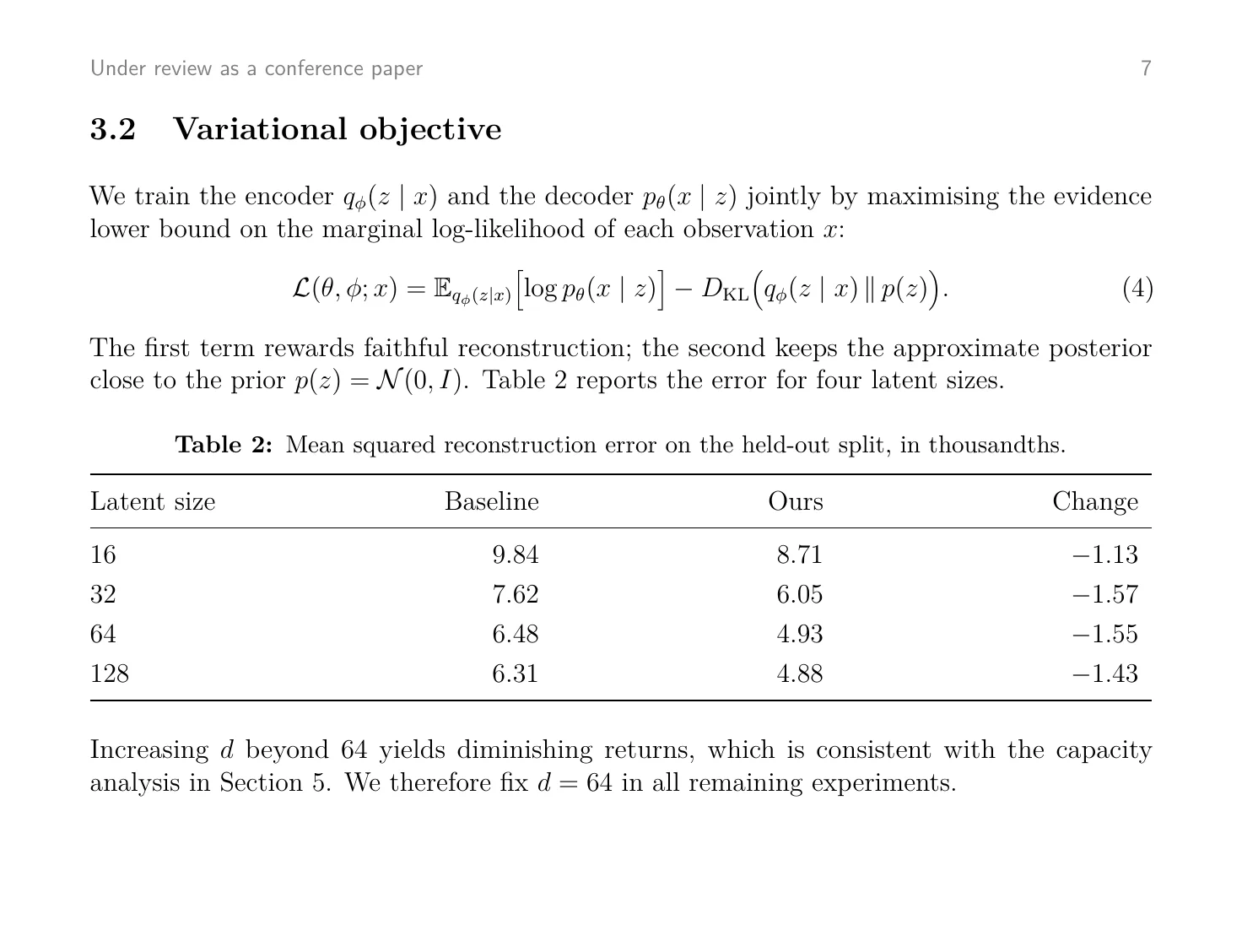
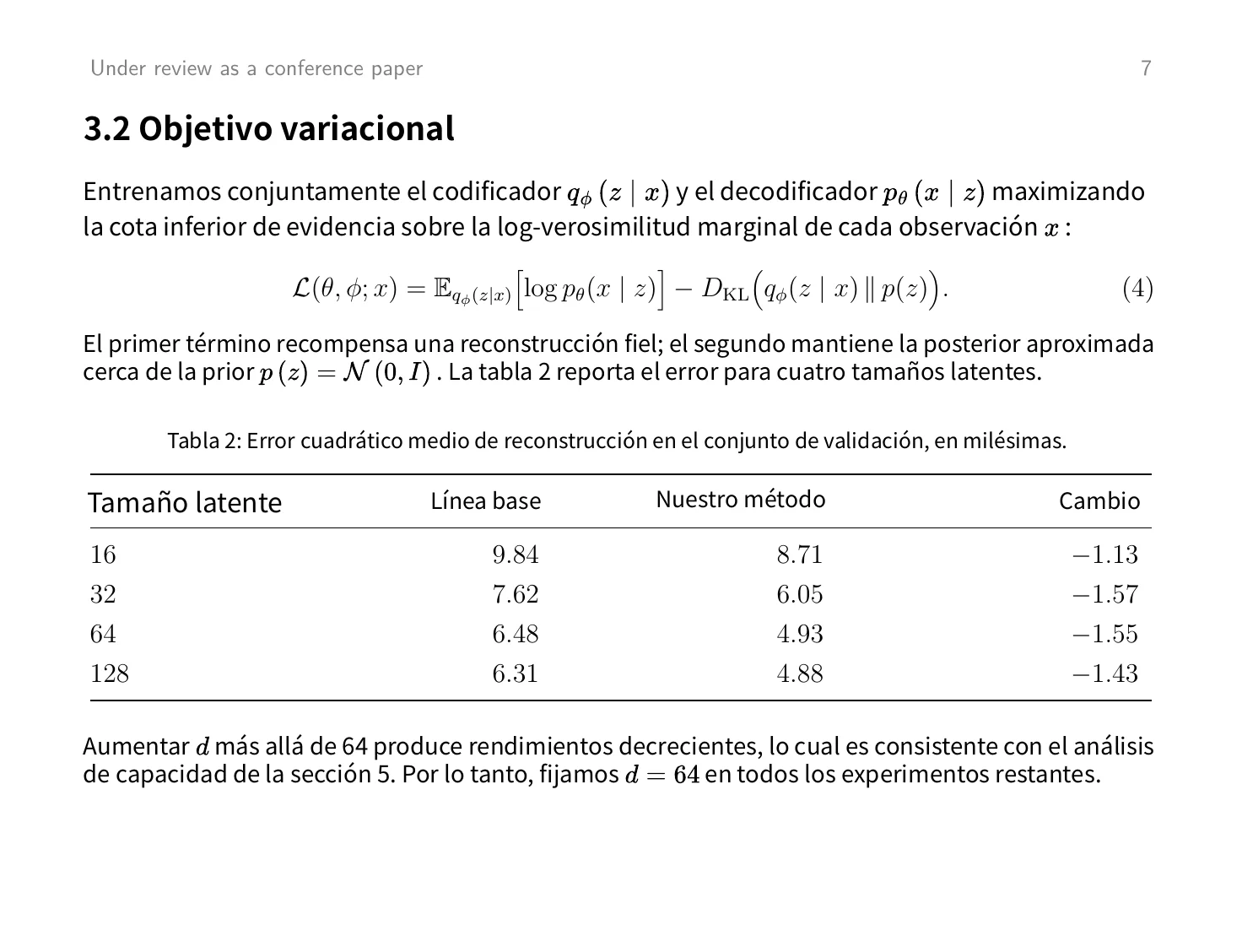
Drag the handle. Left of it is a page as it was uploaded. Right of it is what came back: the same page in Spanish, or the page itself as Markdown or LaTeX.
- 01In the translation, the numbered equation is left exactly as it was and the table keeps its rules and columns.
- 02In the Markdown and the LaTeX, the equation is LaTeX you can edit, not a picture.
- 03The table comes back as rows and cells, with every number in place.
### 3.2 Variational objective

We train the encoder \( {q}_{\phi }\left( {z \mid  x}\right) \) and the decoder \( {p}_{\theta }\left( {x \mid  z}\right) \) jointly by maximising the evidence lower bound on the marginal log-likelihood of each observation \( x \) :

\[
\mathcal{L}\left( {\theta ,\phi ;x}\right)  = {\mathbb{E}}_{{q}_{\phi }\left( {z \mid  x}\right) }\left\lbrack  {\log {p}_{\theta }\left( {x \mid  z}\right) }\right\rbrack   - {D}_{\mathrm{KL}}\left( {{q}_{\phi }\left( {z \mid  x}\right) \parallel p\left( z\right) }\right) .\tag{4}
\]

The first term rewards faithful reconstruction; the second keeps the approximate posterior close to the prior \( p\left( z\right)  = \mathcal{N}\left( {0, I}\right) \) . Table 2 reports the error for four latent sizes.

Table 2: Mean squared reconstruction error on the held-out split, in thousandths.

<table><tr><td>Latent size</td><td>Baseline</td><td>Ours</td><td>Change</td></tr><tr><td>16</td><td>9.84</td><td>8.71</td><td>-1.13</td></tr><tr><td>32</td><td>7.62</td><td>6.05</td><td>-1.57</td></tr><tr><td>64</td><td>6.48</td><td>4.93</td><td>-1.55</td></tr><tr><td>128</td><td>6.31</td><td>4.88</td><td>-1.43</td></tr></table>

Increasing \( d \) beyond 64 yields diminishing returns, which is consistent with the capacity analysis in Section 5. We therefore fix \( d = {64} \) in all remaining experiments.\section*{3.2 Variational objective}
We train the encoder \({q}_{\phi }\left( {z \mid x}\right)\) and the decoder \({p}_{\theta }\left( {x \mid z}\right)\) jointly by maximising the evidence lower bound on the marginal log-likelihood of each observation \(x\) :
\[
\mathcal{L}\left( {\theta ,\phi ;x}\right) = {\mathbb{E}}_{{q}_{\phi }\left( {z \mid x}\right) }\left\lbrack {\log {p}_{\theta }\left( {x \mid z}\right) }\right\rbrack - {D}_{\mathrm{KL}}\left( {{q}_{\phi }\left( {z \mid x}\right) \parallel p\left( z\right) }\right) .\tag{4}
\]
The first term rewards faithful reconstruction; the second keeps the approximate posterior close to the prior \(p\left( z\right) = \mathcal{N}\left( {0,I}\right)\) . Table 2 reports the error for four latent sizes.
Table 2: Mean squared reconstruction error on the held-out split, in thousandths.
\begin{center}
\adjustbox{max width=\textwidth}{
\begin{tabular}{|c|c|c|c|}
\hline
Latent size & Baseline & Ours & Change \\
\cline{1-4}
16 & 9.84 & 8.71 & -1.13 \\
\cline{1-4}
32 & 7.62 & 6.05 & -1.57 \\
\cline{1-4}
64 & 6.48 & 4.93 & -1.55 \\
\cline{1-4}
128 & 6.31 & 4.88 & -1.43 \\
\cline{1-4}
\hline
\end{tabular}
}
\end{center}
Increasing \(d\) beyond 64 yields diminishing returns, which is consistent with the capacity analysis in Section 5. We therefore fix \(d = {64}\) in all remaining experiments.Not a mock-up. The translation is what Doc2X returned on 15 November 2026 with the standard model, unretouched. The Markdown and LaTeX views are the files Doc2X returned for the same page on 15 November 2026, character for character (of the LaTeX file, the part after the preamble). Open the PDF that went in, the PDF that came back, the Markdown file and the LaTeX file.
What it does
One upload, three ways out.
Doc2X rebuilds the structure of the page first: reading order, equations, tables, figures. Everything else works on that structure, which is why the results hold up on the documents that break other tools.
\[
\mathcal{L}\left( {\theta ,\phi ;x}\right) =
{\mathbb{E}}_{{q}_{\phi }\left( {z \mid x}\right) }\left\lbrack {\log {p}_{\theta }} \right\rbrack
- {D}_{\mathrm{KL}}\left( {{q}_{\phi } \parallel p\left( z\right) }\right) .\tag{4}
\]
What goes in, what comes out
PDFs and scans in. A translated PDF out, with the original beside it if you want, or the document itself as an editable file in four formats. Eleven target languages, among them Japanese, Korean and Chinese.
Who uses it
Made for the documents other tools give up on.
Two columns, four hundred pages, a table that runs over three of them, an appendix that was photocopied in 1987. That is the normal case here.
- 01
Researchers
Read a paper in your own language without losing equation numbers, citations or the figure next to the paragraph that explains it.
Research paper translator - 02
Students
Read a scanned textbook chapter in your own language, with the formulas and tables where they were and text you can finally select and search.
Translate a scanned PDF - 03
Engineers
Datasheets, standards and manuals are mostly tables. Get them out as tables, in Word or Markdown, with the units still attached to the numbers.
PDF to Word - 04
Developers
Feed a model clean Markdown instead of a text layer full of broken columns: formulas as LaTeX, tables as rows and cells, a quarter of a credit a page.
PDF to Markdown
Privacy
Your files stay yours.
People upload unpublished papers, contracts and internal reports. We treat every file as if it were one of those.
How files are handledEncrypted on the way in and out
Every upload and every download travels over TLS.
Gone after 31 days
Uploaded files and their results are deleted from our storage automatically, 31 days after upload at the latest.
Not training data for public models
Unless you explicitly agree, your files and translations are not used to train AI models offered to the public or to other customers.
Pricing
Pricing that starts at zero.
Every task shows its cost before it runs, and you pay for what was actually processed. Failed tasks cost nothing.
Free
50 credits a month
$0forever
- About 100 translated pages a month, or 200 converted
- Conversion to Word, Markdown, LaTeX and Typst, and questions about your PDFs
- PDFs up to 20 MB
Starter
1,500 credits a month
$9.90a month, or $99 a year
- Up to 3,000 translated pages a month, or 6,000 converted
- Stronger models that translate with the whole document as context
- Translations as Word, Markdown, LaTeX and Typst, PDFs up to 200 MB
ProRecommended
4,500 credits a month
$24.90a month, or $199 a year
- Up to 9,000 pages a month
- Everything in Starter
- PDFs up to 500 MB
Prices in US dollars. See what a credit buys
What makes Doc2X different from pasting a PDF into a chatbot?
A chatbot reads the text layer and guesses at the rest. Doc2X first rebuilds the page: reading order across columns, every equation, every table as rows and cells. The translation is then set back into that structure, which is why a formula comes out as a formula and a table keeps its columns.
Does it work on scanned PDFs?
Yes. Scanned pages are read with OCR that handles print, formulas and tables. The translation is set into the scanned page as real text you can select and search.
Which languages can I translate into?
Eleven targets today: English, Spanish, Portuguese (Brazil and Portugal), German, French, Japanese, Korean, Simplified and Traditional Chinese, and Russian, which is in beta. The interface itself is available in 11 languages.
What do I get back?
From a translation: a translated PDF that keeps the original layout, on its own or with the original beside it on every page; Starter and Pro can also take the translation as Word, Markdown, LaTeX or Typst. From a conversion, on every plan: the document itself as Word, Markdown, LaTeX or Typst, with the equations and tables editable.
Is it free?
The free plan includes 50 credits every month and needs no card. That is about 100 translated pages with the standard model, or 200 pages converted without translating; an answer to a question costs half a credit. A task shows its cost before it starts, and a task that fails is not charged. Paid plans start at $9.90 a month.
Can I ask questions about a PDF?
Yes. Open a document you have translated or converted and ask in your own language. The answer is written from the document, names the pages it draws on, and a click on a page number takes the reader there. When the document does not say, the answer says so.
What happens to my files?
Uploads and downloads are encrypted in transit. Unless you explicitly agree, your files and translations are not used to train AI models offered to the public or to other customers. Uploaded files and their results are deleted from our storage automatically, 31 days after upload at the latest.
Bring the PDF that broke the last tool.
The free plan is enough to find out whether it survives.