Skip to content
Doc2X

Turn a PDF into flashcards and a quiz.

Choose a PDF, the notes of a recording, or paste your own notes. Doc2X writes a summary, the key points, flashcards and a multiple-choice quiz from it. For a document, every card and every question names the page it was written from, so a doubtful answer is one look away.

Make a study set

Question

What does RuBisCO do in carbon fixation?

Answer

RuBisCO joins one CO2 to the five-carbon sugar RuBP; the six-carbon product splits at once into two molecules of 3-PGA.

Card 9 of 12 p. 2From a 2-page handout
From
A PDF, the notes of a recording, or text you paste
How much
Quick, regular or thorough: 8 to 20 cards, 5 to 12 questions
Language
The document’s, or one of 12 you choose
Open Study

Free plan: 50 credits every month, no card needed. That is 10 study sets.

Nothing at hand? See the set a two-page handout came back as

From
A PDF, a document already in your account, the notes of a recording, or up to 12,000 characters of pasted text
Back
A summary, key points as a list or as a map, flashcards, and a quiz that says why each answer is right
Cost
5 credits a set, whatever its size, charged when the set is ready

One handout, its study set

Two pages of biology, as they came back.

This is the set for a two-page handout on photosynthesis: 12 cards, 8 questions, a summary and 10 key points. Open a card to see its answer, and a question to see which option is right and why.

  • 01Every card and every question names its page, and the right one: 7 cards are from page 1, 5 from page 2.
  • 02We read all 12 cards and all 8 questions against the handout: each says what the handout says.
  • 03The set was written 13.4 seconds after it was asked for, and cost 5 credits.

Study set12 cards 8 questions 10 key points

Photosynthesis: light reactions, Calvin cycle, limiting factors

The handout explains how plants, algae and some bacteria convert light energy into sugar, starting with the overall equation for photosynthesis. It describes where photosynthesis happens in the chloroplast and separates the process into light-dependent reactions in the thylakoid membrane and the Calvin cycle in the stroma, showing how the two stages feed each other. It then covers pigments and leaf colour, the factors that limit the rate, and how C4 and CAM plants avoid photorespiration. From this it follows that the oxygen released comes from water, that the Calvin cycle depends on ATP and NADPH from the light reactions, and that the rate of photosynthesis is set by whichever factor is in shortest supply.

The key points: 10, as they came
  1. 01Photosynthesis takes place in chloroplasts, mainly in the mesophyll cells of a leaf, with the light-dependent reactions in the thylakoid membrane and the Calvin cycle in the stroma.
  2. 02The oxygen released by a plant comes from water split in photolysis at photosystem II, not from carbon dioxide.
  3. 03The light-dependent reactions make three things: ATP, NADPH and O2.
  4. 04The Calvin cycle does not use light directly but depends on ATP and NADPH from stage one, so in a living plant it runs in daylight.
  5. 05Three turns of the Calvin cycle fix 3 CO2 and give a net gain of one G3P, at a cost of 9 ATP and 6 NADPH.
  6. 06Chlorophyll a and b absorb mostly red and blue-violet light and reflect green, which is why leaves look green.
  7. 07The rate of photosynthesis is set by the limiting factor, whichever of light intensity, CO2 concentration or temperature is in shortest supply.
  8. 08When stomata close, O2 builds up and RuBisCO fixes O2 instead of CO2, a wasteful process called photorespiration.
  9. 09C4 plants such as maize and sugarcane first fix CO2 into a four-carbon compound and deliver it to RuBisCO in bundle-sheath cells, where the CO2 level stays high.
  10. 10CAM plants such as cacti and pineapple open their stomata at night, store CO2 as an acid, and use it by day.
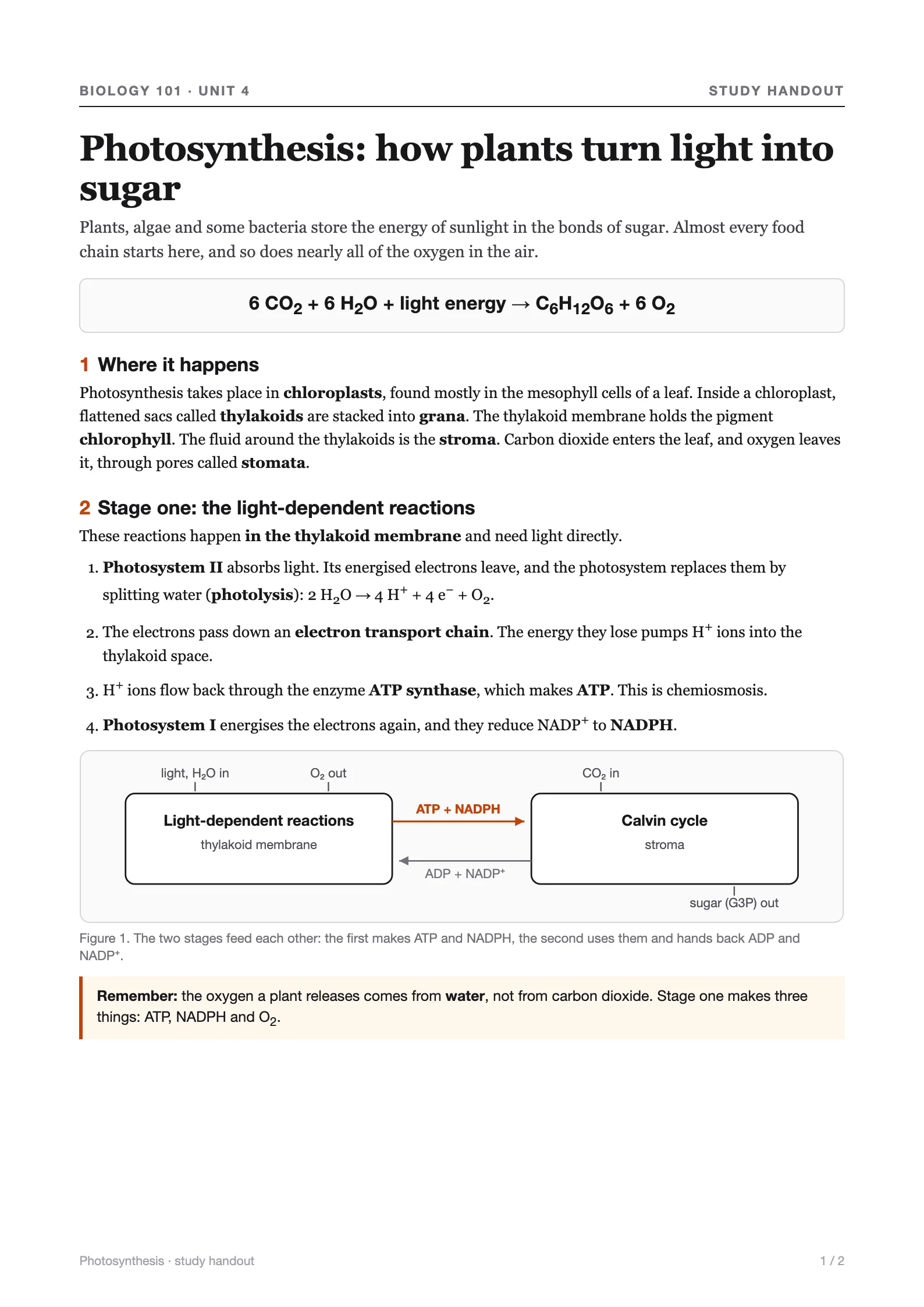
Page 1 of the two-page handout on photosynthesis that the study set was made from.
Page 1 of the handout

7 flashcards from page 1

  • In which organelle, and in which leaf cells, does photosynthesis mainly happen?

    Photosynthesis takes place in chloroplasts, found mostly in the mesophyll cells of a leaf.p. 1

  • What are the thylakoids, the grana and the stroma?

    Thylakoids are flattened sacs inside a chloroplast, stacked into grana; their membrane holds chlorophyll. The fluid around the thylakoids is the stroma.p. 1

  • What are stomata and what passes through them?

    Stomata are pores in the leaf through which carbon dioxide enters and oxygen leaves.p. 1

  • Where does the oxygen released in photosynthesis come from?

    It comes from water, which is split in photolysis at photosystem II: 2H2O → 4H+ + 4e− + O2.p. 1

  • What is chemiosmosis in the light-dependent reactions?

    H+ ions pumped into the thylakoid space flow back through the enzyme ATP synthase, which makes ATP.p. 1

  • What does photosystem I do with the energised electrons?

    Photosystem I energises the electrons again, and they reduce NADP+ to NADPH.p. 1

  • What three products does stage one of photosynthesis make?

    The light-dependent reactions make ATP, NADPH and O2.p. 1
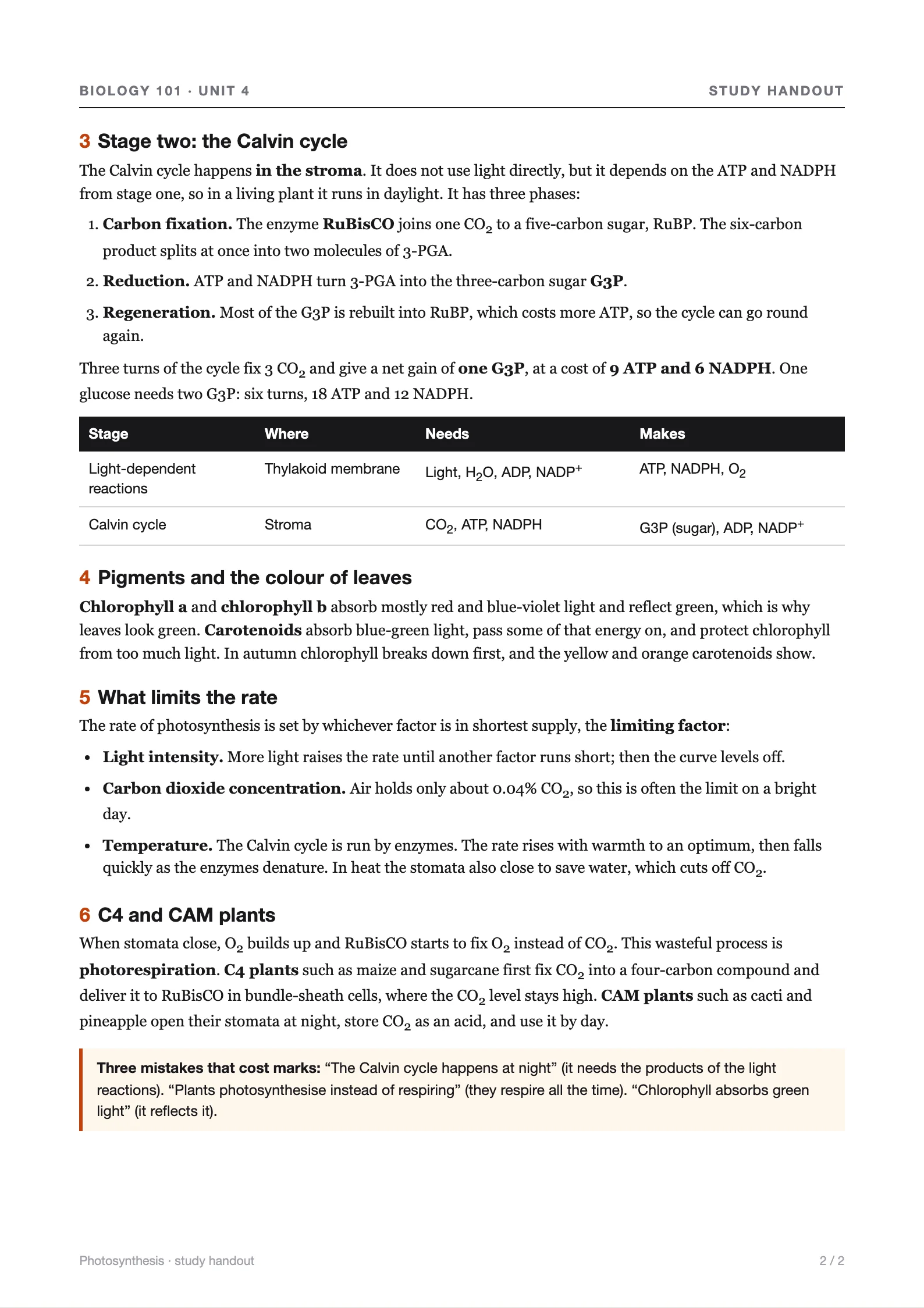
Page 2 of the two-page handout on photosynthesis that the study set was made from.
Page 2 of the handout

5 flashcards from page 2

  • What are the three phases of the Calvin cycle?

    Carbon fixation, reduction and regeneration. Fixation joins CO2 to RuBP, reduction turns 3-PGA into G3P, and regeneration rebuilds RuBP from most of the G3P.p. 2

  • What does RuBisCO do in carbon fixation?

    RuBisCO joins one CO2 to the five-carbon sugar RuBP; the six-carbon product splits at once into two molecules of 3-PGA.p. 2

  • What does three turns of the Calvin cycle cost and yield?

    Three turns fix 3 CO2 and give a net gain of one G3P, at a cost of 9 ATP and 6 NADPH.p. 2

  • Why do leaves look green, and what do carotenoids do?

    Chlorophyll a and b absorb mostly red and blue-violet light and reflect green. Carotenoids absorb blue-green light, pass some energy on, and protect chlorophyll from too much light.p. 2

  • What is photorespiration and which plants avoid it how?

    When stomata close, O2 builds up and RuBisCO fixes O2 instead of CO2, a wasteful process called photorespiration. C4 plants deliver CO2 to RuBisCO in bundle-sheath cells, and CAM plants store CO2 as an acid overnight.p. 2

The quiz: 8 questions, four options each

  1. 01Why does the Calvin cycle run in daylight in a living plant, even though it does not use light directly?

    1. ABecause RuBisCO is only active when light strikes the stroma
    2. BBecause it depends on the ATP and NADPH made by the light-dependent reactions
    3. CBecause the stroma only forms while the thylakoid membrane is illuminated
    4. DBecause carbon dioxide can only enter the leaf in daylight
    Show the answer

    B. The cycle itself uses no light, but it needs the ATP and NADPH from stage one, so it runs while those are being supplied. p. 2

  2. 02A plant is given bright light and warmth but its rate of photosynthesis levels off. According to the handout, what most likely limits it?

    1. AThe temperature has passed the optimum and enzymes are denaturing
    2. BChlorophyll is reflecting too much red and blue-violet light
    3. CCarbon dioxide concentration, since air holds only about 0.04% CO2
    4. DThe stomata are closed because the plant is respiring
    Show the answer

    C. More light raises the rate only until another factor runs short; with light and warmth plentiful, the low CO2 content of air is often the limit on a bright day. p. 2

  3. 03Why do C4 plants such as maize deliver CO2 to RuBisCO in bundle-sheath cells?

    1. ATo keep the CO2 level high there so RuBisCO fixes CO2 rather than O2
    2. BTo keep oxygen out of the leaf so that photolysis cannot occur
    3. CTo store CO2 as an acid overnight for use the next day
    4. DTo let the Calvin cycle run at night when stomata are open
    Show the answer

    A. C4 plants first fix CO2 into a four-carbon compound and release it in bundle-sheath cells, where the high CO2 level suppresses photorespiration. p. 2

The other 5 questions, each with its answer and the reason
  1. 04What happens to the rate of photosynthesis as temperature rises well above the optimum?

    1. AIt keeps rising steadily because more heat means more light energy
    2. BIt stays constant because temperature is never a limiting factor
    3. CIt falls quickly because the enzymes of the Calvin cycle denature
    4. DIt falls because chlorophyll begins to absorb green light

    C. The Calvin cycle is run by enzymes; the rate rises to an optimum and then falls quickly as the enzymes denature. p. 2

  2. 05How many turns of the Calvin cycle, and how much ATP and NADPH, are needed for one glucose?

    1. AThree turns, 9 ATP and 6 NADPH
    2. BSix turns, 9 ATP and 6 NADPH
    3. CThree turns, 18 ATP and 12 NADPH
    4. DSix turns, 18 ATP and 12 NADPH

    D. One glucose needs two G3P, and each G3P costs three turns, 9 ATP and 6 NADPH, so the total is six turns, 18 ATP and 12 NADPH. p. 2

  3. 06Why do the yellow and orange carotenoids become visible in autumn leaves?

    1. AChlorophyll breaks down first, so the carotenoids that were there all along show
    2. BCarotenoids are newly made in autumn to protect the leaf from cold
    3. CThe leaf stops reflecting green light once the days get shorter
    4. DCarotenoids absorb green light, which becomes stronger in autumn

    A. In autumn chlorophyll breaks down first, and the yellow and orange carotenoids, which were already present, show through. p. 2

  4. 07What is the role of water splitting at photosystem II?

    1. AIt provides the CO2 that RuBisCO later fixes in the stroma
    2. BIt replaces the energised electrons that left photosystem II and releases O2
    3. CIt pumps H+ ions into the thylakoid space to drive ATP synthase
    4. DIt reduces NADP+ to NADPH for use in the Calvin cycle

    B. Photolysis replaces the electrons lost by photosystem II and, in doing so, releases the oxygen the plant gives off. p. 1

  5. 08A student claims that plants photosynthesise instead of respiring. Why is this wrong according to the handout?

    1. ABecause respiration happens only in the dark, when photosynthesis stops
    2. BBecause plants respire all the time, alongside photosynthesis
    3. CBecause respiration takes place only in the roots, not in the leaves
    4. DBecause plants do not respire at all and rely on photosynthesis alone

    B. The handout lists this as a mark-losing mistake: plants respire all the time, not instead of photosynthesising. p. 2

Not a mock-up. This is the study set Doc2X returned on 22 November 2026 for a handout of our own: two pages on photosynthesis, written for this page. The PDF was converted first, which took 13 seconds and cost 0.5 credits. The set was then asked for with nothing changed on the Study page (the size it offers first, the language of the handout), was written in 13.4 seconds and cost 5 credits. Cards, questions, reasons and page numbers are as they came; nothing was changed afterwards. Open the handout that went in.

Why you can study from it

A set you can check, change and take along.

  1. Page 2 of the handout on photosynthesis: the Calvin cycle, pigments and what limits the rate.p. 2
    • What are the three phases of the Calvin cycle?

      Flashcardp. 2

    • What does RuBisCO do in carbon fixation?

      Flashcardp. 2

    • What does three turns of the Calvin cycle cost and yield?

      Flashcardp. 2

    Three of the 5 cards written from page 2 of the handout, each with its page

    01

    Every card names its page

    Each card and each question made from a document says which page it was written from. When an answer looks doubtful, you know where to look, and checking it takes a moment.

  2. Question 7 of 8p. 1

    What is the role of water splitting at photosystem II?

    1. AIt provides the CO2 that RuBisCO later fixes in the stroma
    2. BIt replaces the energised electrons that left photosystem II and releases O2
    3. CIt pumps H+ ions into the thylakoid space to drive ATP synthase
    4. DIt reduces NADP+ to NADPH for use in the Calvin cycle

    Right. Photolysis replaces the electrons lost by photosystem II and, in doing so, releases the oxygen the plant gives off.

    A question of the set with the right option marked, and the reason the set gives for it

    02

    A quiz that says why

    Four options a question, checked the moment you choose, with the reason the right one is right. At the end the quiz says how many you got right and offers the ones you missed again.

  3. Key points10 in all
    1. 01Photosynthesis takes place in chloroplasts, mainly in the mesophyll cells of a leaf, with the light-dependent reactions in the thylakoid membrane and the Calvin cycle in the stroma.
    2. 02The oxygen released by a plant comes from water split in photolysis at photosystem II, not from carbon dioxide.
    3. 03The light-dependent reactions make three things: ATP, NADPH and O2.
    4. 04The Calvin cycle does not use light directly but depends on ATP and NADPH from stage one, so in a living plant it runs in daylight.
    5. 05Three turns of the Calvin cycle fix 3 CO2 and give a net gain of one G3P, at a cost of 9 ATP and 6 NADPH.
    The first five of the 10 key points, as they came

    03

    The summary first

    Before the cards there is a summary of the document and its key points, as a list or as a map whose branches open and close. The map downloads as SVG or PNG.

  4. Language of the setThe handout’s

    What does RuBisCO do in carbon fixation?

    RuBisCO joins one CO2 to the five-carbon sugar RuBP; the six-carbon product splits at once into two molecules of 3-PGA.

    Language of the setSpanish

    ¿Qué hace RuBisCO en la fijación de carbono?

    Une un CO2 a la RuBP, un azúcar de cinco carbonos. El producto de seis carbonos se divide de inmediato en dos moléculas de 3-PGA.

    The same handout, asked for twice: the card about RuBisCO in each set

    04

    In the language you study in

    A set is written in the language of the material, or in one of twelve you choose. A handout in English can be studied in Spanish: the cards ask the same things in the other language.

  5. Cards for Anki12 lines
    1. In which organelle, and in which leaf cells, does photosynthesis mainly happen?Photosynthesis takes place in chloroplasts, found mostly in the mesophyll cells of a leaf.
    2. What are the thylakoids, the grana and the stroma?Thylakoids are flattened sacs inside a chloroplast, stacked into grana; their membrane holds chlorophyll. The fluid around the thylakoids is the stroma.
    3. What are stomata and what passes through them?Stomata are pores in the leaf through which carbon dioxide enters and oxygen leaves.
    4. Where does the oxygen released in photosynthesis come from?It comes from water, which is split in photolysis at photosystem II: 2H2O → 4H+ + 4e− + O2.
    The first four lines of the cards file: a question, a tab, its answer

    05

    Yours to change and to take along

    Change any card, question or key point, add your own, and put back the set as it was made whenever you like. The cards download as a tab-separated file that Anki, Quizlet and similar apps import; the whole set downloads as Markdown.

How it works

Three steps from a document to a quiz.

  1. 01

    Choose what to study

    Open Study and add a PDF (it is converted first, at 0.25 credits a page), choose a document already in your account or the notes of a recording, or paste up to 12,000 characters. Up to five documents and recordings can go into one set.

  2. 02

    Say how much, and in which language

    Quick is 8 cards and 5 questions, regular 12 and 8, thorough 20 and 12. Keep the language of the material or choose one of 12, and say what to concentrate on if you like. The page says what the set costs before you start.

  3. 03

    Turn, answer, repeat

    The set usually opens in under a minute. Go through the cards, take the quiz, repeat only what you missed, and change any card to how you would put it.

The fine print

What it takes and what it gives back.

Better to know before you start. The last list is what it does not do today.

Made from
A PDF you add on the page, a document already in your account, the notes of a recording, or up to 12,000 characters of pasted text
Several sources
Up to 5 documents and recordings in one set; each card and question then says which one it comes from
Long documents
A document is read whole up to about 80,000 characters in the Latin alphabet (roughly 25 pages of a textbook in English), or about 18,000 characters in other scripts such as Chinese, Russian or Arabic. A longer one is read in full from the start as far as that goes, and by its headings after that; the set then says how many of its pages were read. Several sources share twice as much
How much
Quick: 8 cards and 5 questions. Regular: 12 and 8. Thorough: 20 and 12
Language
The language of the material, or one of 12 you choose: Arabic, Chinese (Simplified or Traditional), English, French, German, Italian, Japanese, Korean, Portuguese (Brazil), Russian or Spanish
What comes back
A title and a summary; key points; flashcards, each a question and its answer; a multiple-choice quiz with four options a question and the reason the right one is right. For a document, cards and questions name their page
On the page
Cards can be shuffled and marked as known or to go over, and the ones to go over repeated. The quiz is checked as you choose and offers the missed questions again. The key points are also a map that opens and closes
Changing it
Key points, cards and questions can be changed, added and removed; the set as it was made can be put back
Files
The cards as a tab-separated file, question then answer, that Anki, Quizlet and similar apps import; the whole set as Markdown; the map as SVG or PNG
How long it takes
The set on this page was written in 13.4 seconds. A PDF is converted first: the two pages of this handout took 13 seconds
Cost
5 credits a set whatever its size, 10 credits for a set from several sources, on every plan, charged when the set is ready. A PDF that is not in your account yet is converted first, at 0.25 credits a page. A set that could not be made costs nothing, and neither does going through the cards and the quiz
Storage
Sets are kept for 31 days, then deleted. You can delete them sooner

Not a fit yet

  • A whole textbook in one set. A set is written from about the first 80,000 characters of a document in English, so add a book a chapter at a time.
  • A schedule that brings cards back over days. The page repeats what you missed in the same sitting; for spaced repetition, take the cards to Anki.
  • Pictures on cards. A card is a question and an answer in text.
  • A set without a slip. It is written by an AI model and can be wrong; the page numbers are there so that you can check.
  • More than 20 cards or 12 questions written in one go. Add your own afterwards, or make a second set.
  • Sharing a set by a link. Download the set or the cards to pass them on.

Questions

Questions people ask first.

Something else on your mind? The help center goes deeper.

How do I make flashcards from a PDF?

Open Study, add the PDF or choose a document already in your account, pick how much you want and click Make the study set. It usually opens in under a minute: a summary, key points, flashcards and a quiz.

Is it free?

The free plan gives you 50 credits every month and needs no card. A study set costs 5 credits, so a month of the free plan covers 10 sets. A PDF that is not in your account yet is converted first, at 0.25 credits a page.

Can I import the cards into Anki or Quizlet?

Yes. “Cards for Anki” downloads a tab-separated file, question then answer, one card a line, which Anki, Quizlet and similar apps import. The whole set also downloads as Markdown.

Does it make a quiz as well?

Yes. Every set has a multiple-choice quiz of 5, 8 or 12 questions with four options each. An answer is checked the moment you choose it, with the reason the right one is right, and at the end you can repeat the ones you missed.

How many flashcards does it make?

You choose: quick is 8 cards, regular 12, thorough 20. Afterwards you can add cards of your own, change any card, or remove it.

How long can the PDF be?

Any length you can upload. A document is read whole up to about 80,000 characters in the Latin alphabet (roughly 25 pages of a textbook in English), or about 18,000 characters in other scripts such as Chinese, Russian or Arabic. A longer one is read from the start, and the set says how many of its pages were read. For a whole book, make one set a chapter: Split PDF, one of the free tools on this site, cuts a chapter out by its pages or by the bookmarks of the book.

Can I trust what it writes?

A set is written by an AI model from your material, and it can be wrong. For a document, each card and each question names the page it comes from, so it is quick to check, and you can change or remove anything. We read the set on this page against its handout: all 12 cards and all 8 questions say what the handout says and name the right page. Longer and harder material leaves a model more room to slip, which is what the page numbers are for.

Can I make flashcards from a lecture recording?

Yes. Make notes from the recording on the Notes page first, then choose those notes as the source of a study set. Up to five documents and recordings can go into one set.

Which languages does it work in?

A set is written in the language of your material or in one of 12 you choose, among them Spanish, French, German, Japanese, Korean and Arabic. A handout in English can be studied in Spanish.

Bring the chapter you have to know by Friday.

Start on the free plan. No card needed.