Ask a PDF and get the page number back.
Upload a PDF and ask it questions in your own language. The answer is written from the document, names the pages it draws on, and a click on a page number takes you there. Formulas, tables and scanned pages are read, not skipped.
No file at hand? See what the model is given to read
- From
- Any PDF, scanned or digital, up to 20 MB on the free plan
- Back
- Answers with page references, beside the document they come from
- Cost
- Reading the PDF: a quarter of a credit a page. Each answer: half a credit
What the model reads
Not the text layer. The page.
Drag the handle. Left of it is a page of a PDF. Right of it is that page as Doc2X hands it to the model: the Markdown it converted the page to.
- 01The equation reaches the model as LaTeX, with its number, not as loose symbols.
- 02The table reaches it as rows and cells, so a question about one number finds that number.
- 03A scanned page reaches it the same way: for this page, the scan gave the same text.
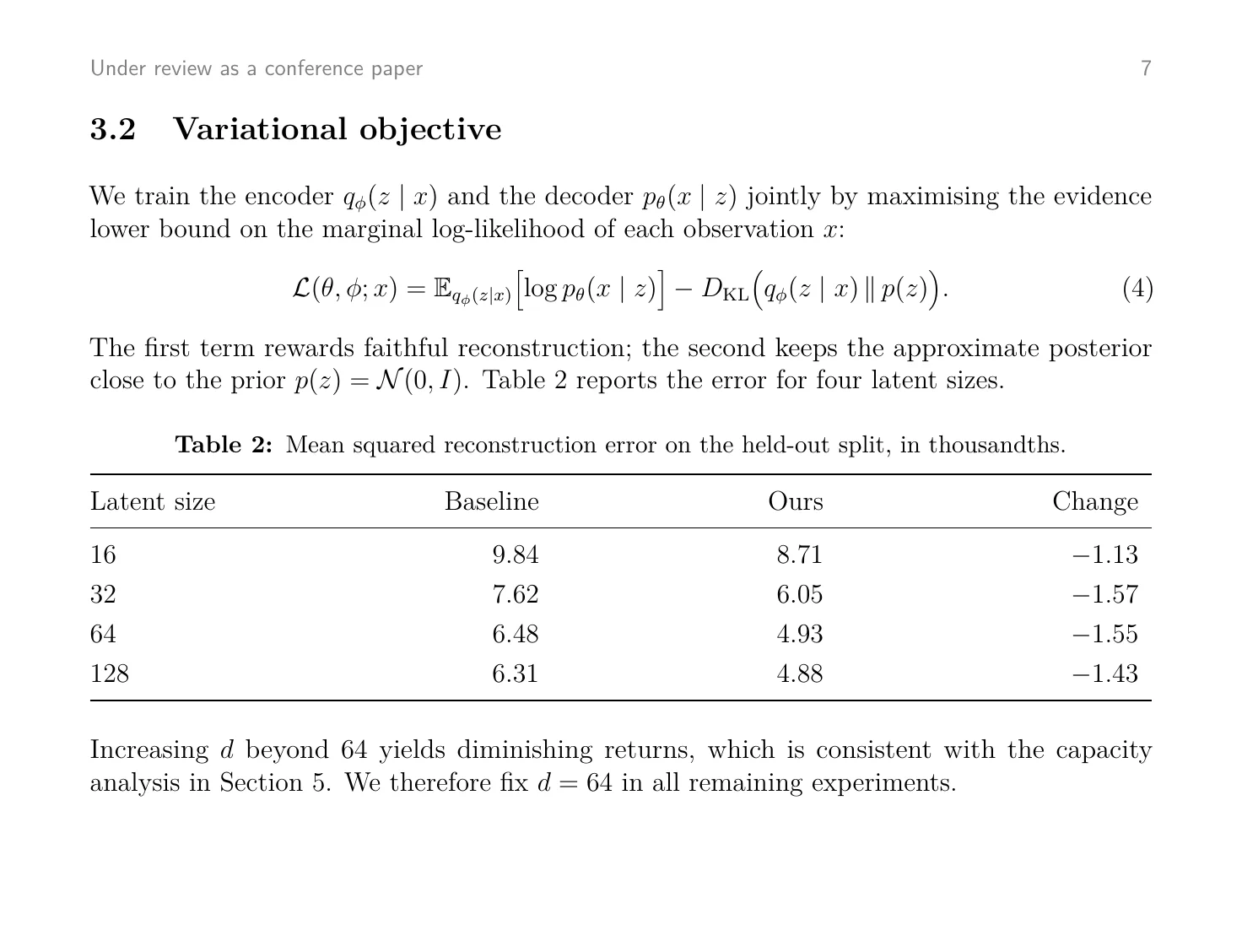
### 3.2 Variational objective

We train the encoder \( {q}_{\phi }\left( {z \mid  x}\right) \) and the decoder \( {p}_{\theta }\left( {x \mid  z}\right) \) jointly by maximising the evidence lower bound on the marginal log-likelihood of each observation \( x \) :

\[
\mathcal{L}\left( {\theta ,\phi ;x}\right)  = {\mathbb{E}}_{{q}_{\phi }\left( {z \mid  x}\right) }\left\lbrack  {\log {p}_{\theta }\left( {x \mid  z}\right) }\right\rbrack   - {D}_{\mathrm{KL}}\left( {{q}_{\phi }\left( {z \mid  x}\right) \parallel p\left( z\right) }\right) .\tag{4}
\]

The first term rewards faithful reconstruction; the second keeps the approximate posterior close to the prior \( p\left( z\right)  = \mathcal{N}\left( {0, I}\right) \) . Table 2 reports the error for four latent sizes.

Table 2: Mean squared reconstruction error on the held-out split, in thousandths.

<table><tr><td>Latent size</td><td>Baseline</td><td>Ours</td><td>Change</td></tr><tr><td>16</td><td>9.84</td><td>8.71</td><td>-1.13</td></tr><tr><td>32</td><td>7.62</td><td>6.05</td><td>-1.57</td></tr><tr><td>64</td><td>6.48</td><td>4.93</td><td>-1.55</td></tr><tr><td>128</td><td>6.31</td><td>4.88</td><td>-1.43</td></tr></table>

Increasing \( d \) beyond 64 yields diminishing returns, which is consistent with the capacity analysis in Section 5. We therefore fix \( d = {64} \) in all remaining experiments.
Not a mock-up. The Markdown view is the file Doc2X returned for the same page on 15 November 2026, character for character. Open the PDF that went in and the Markdown file.
Why the answers hold up
Answers you can check.
What does Table 2 report, and which latent size do the authors keep?
Table 2 reports the mean squared reconstruction error on the held-out split, in thousandths, for four latent sizes, comparing a Baseline with "Ours" and the resulting change p. 1:
Latent size Baseline Ours Change 16 9.84 8.71 −1.13 32 7.62 6.05 −1.57 64 6.48 4.93 −1.55 128 6.31 4.88 −1.43 The authors keep d = 64 in all remaining experiments, since increasing d beyond 64 yields diminishing returns, consistent with the capacity analysis in Section 5 p. 1.
Asked about the sample page on 15 November 2026. The answer is word for word what came back; the first words arrived after 1.3 seconds. 01
Every answer names its pages
The model is told to answer from the document only and to say which page each statement comes from. This is an answer about the sample page on this site, word for word as it came back.
- In the readerp. 1page 1
A page number in an answer is a link. It takes the reader, on the left of the answer, to that page. 02
A page number is a link
The answer sits beside the document. Click a page number in it and the reader moves to that page, so checking a claim takes one click instead of a search.
Why do they stop at 64?
Because increasing d beyond 64 yields diminishing returns, which the authors say is consistent with the capacity analysis in Section 5 p. 1.
The table supports this: going from 64 to 128 only improves the error from 4.93 to 4.88 (a change of −1.43 versus −1.55 at 64), so the extra latent capacity buys very little p. 1. The document does not give any further reason beyond this.
The next question in the same conversation on 15 November 2026. The answer is word for word what came back; the first words arrived after 0.9 seconds. 03
It says when the document does not say
Asked for more than the page holds, it answers with what is there and says that the document gives nothing further. A follow-up question is understood from the ones before it.
The pagePDF \[ \mathcal{L}\left( {\theta ,\phi ;x}\right) = {\mathbb{E}}_{{q}_{\phi }\left( {z \mid x}\right) }\left\lbrack {\log {p}_{\theta }\left( {x \mid z}\right) }\right\rbrack - {D}_{\mathrm{KL}}\left( {{q}_{\phi }\left( {z \mid x}\right) \parallel p\left( z\right) }\right) .\tag{4} \]The same equation in converted.md, as downloaded 04
Formulas and tables are part of the text
Before any question is asked, the PDF is converted the way Doc2X converts every PDF: formulas to LaTeX, tables to rows and cells, two columns into reading order. That is what the model reads.
How it works
Three steps from PDF to answer.
01
Upload the PDF
Drop it into the box at the top of this page, with a first question if you have one. Up to 20 MB on the free plan, 200 MB on Starter and 500 MB on Pro.
02
Doc2X reads it
The document is converted once, at a quarter of a credit a page; the total is shown before you start. A page takes a few seconds. It then opens with the question panel beside it.
03
Ask
Type a question, or send the one you brought. The first words of an answer arrive in a second or two. Each answer costs half a credit; a question that gets no answer costs nothing.
The fine print
What it takes and what it gives back.
Better to know before you upload. The last list is what it does not do today.
- Files
- PDF, digital or scanned. Documents you have translated here can be asked about too
- File size
- 20 MB on Free, 200 MB on Starter, 500 MB on Pro
- Languages
- Ask in any language; the answer comes in the language of the question
- What the model reads
- The whole document when it fits. For a long one, the pages that match the question best and an outline of the rest; the answer then says how many pages it was based on
- Answers
- Written as they arrive, with page references that move the reader, formulas typeset and tables as tables
- Model
- DeepSeek V4 Flash
- Cost
- Reading the PDF: a quarter of a credit a page, once. Each answer: half a credit. An answer you stop after it has begun is charged; one that fails is not
- Limits
- A question of up to 4,000 characters; 40 questions in 10 minutes
- Storage
- Uploaded files and results are deleted automatically within 31 days. Conversations are not stored: they last as long as the page is open
Not a fit yet
- Questions across several documents at once. One conversation is about one document.
- What a figure shows. The model reads text, formulas and tables, and the caption of a figure, not the picture itself.
- Conversations you can come back to. Reload the page and the conversation is gone; the document stays in your history.
- Photos, Word, PowerPoint or EPUB files. Only PDFs are taken today.
How do I chat with a PDF?
Upload it here. Doc2X reads the document once, then opens it with a question panel beside it. Type a question; the answer is written from the document and names the pages it comes from.
Is it free?
The free plan gives you 50 credits every month and needs no card. Reading a PDF costs a quarter of a credit a page and each answer half a credit, so a 20-page paper and 90 answers fit in a month of the free plan. The cost of reading is shown before you start.
How do I know the answer is right?
Every answer says which page each statement comes from, and a click on the page number takes the reader there, so you can check it against the source. When the document does not answer the question, the answer says so. It is still written by a language model: check what matters.
Does it read formulas and tables?
Yes, and that is the difference to tools that work from the text layer of a PDF. The document is first converted: formulas to LaTeX, tables to rows and cells. The model reads that, so it can quote a value from a table or explain a term of an equation.
Does it work on scanned PDFs?
Yes. Scanned pages are read with OCR that handles print, formulas and tables before any question is asked.
Can I ask in my own language about a PDF in another one?
Yes. Ask in any language; the answer comes in the language of your question, whatever language the document is in.
How long a document can it handle?
Any length you can upload. A document that fits is read whole. For a longer one, each question is answered from the pages that match it best together with an outline of the rest, and the answer tells you how many of the pages it was based on.
What happens to my file and my questions?
The file is uploaded over an encrypted connection and deleted automatically within 31 days. Conversations are not stored on our side: they last as long as the page is open. Unless you explicitly agree, your files are not used to train AI models offered to the public or to other customers.
Ask the PDF you are stuck on.
Start on the free plan. No card needed.