Notes1:49 4 sections 15 sentences
Gradient Descent, Learning Rate, and Momentum
The lecture introduces gradient descent as a way to minimize a loss function that measures how wrong a model is. It explains that the learning rate sets the step size: too small and training takes forever, while too large is also problematic. Momentum addresses the zigzagging of plain gradient descent in narrow valleys by keeping a running average of past gradients, called the velocity. The main conclusions are that gradient descent follows the slope downhill, and the learning rate must be neither too small nor too large.
0:00Introduction and the idea of gradient descent
- The lecture covers what gradient descent is, how the learning rate changes its behavior, and why momentum helps.
- We have a function that measures how wrong our model is, and we call it the loss.
- Gradient descent looks at the slope of the loss at the current parameters and takes a small step downhill.
- We repeat this until the loss stops getting smaller.
- Each step uses the gradient, which is the vector of partial derivatives of the loss with respect to every parameter.
0:34The learning rate
- The learning rate is the size of each step.
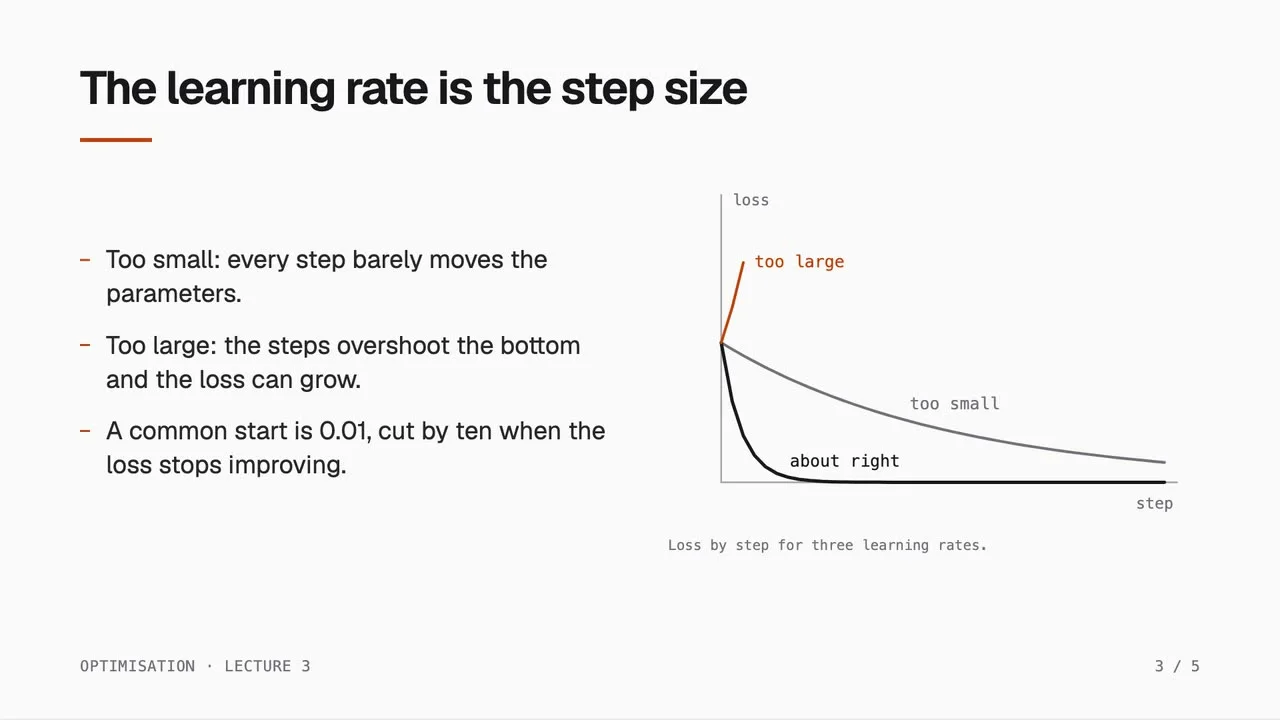
- If the learning rate is too small, training takes forever, because every step barely moves the parameters.
- If the learning rate is too large, the steps overshoot the bottom of the valley and the loss can even grow.
- A common starting value is 0.01, and people often reduce it by a factor of ten when the loss stops improving.
- In the experiment, a learning rate of 0.1 diverged after twenty steps, while 0.01 reached a loss of 0.3 after two hundred steps.
1:08Momentum
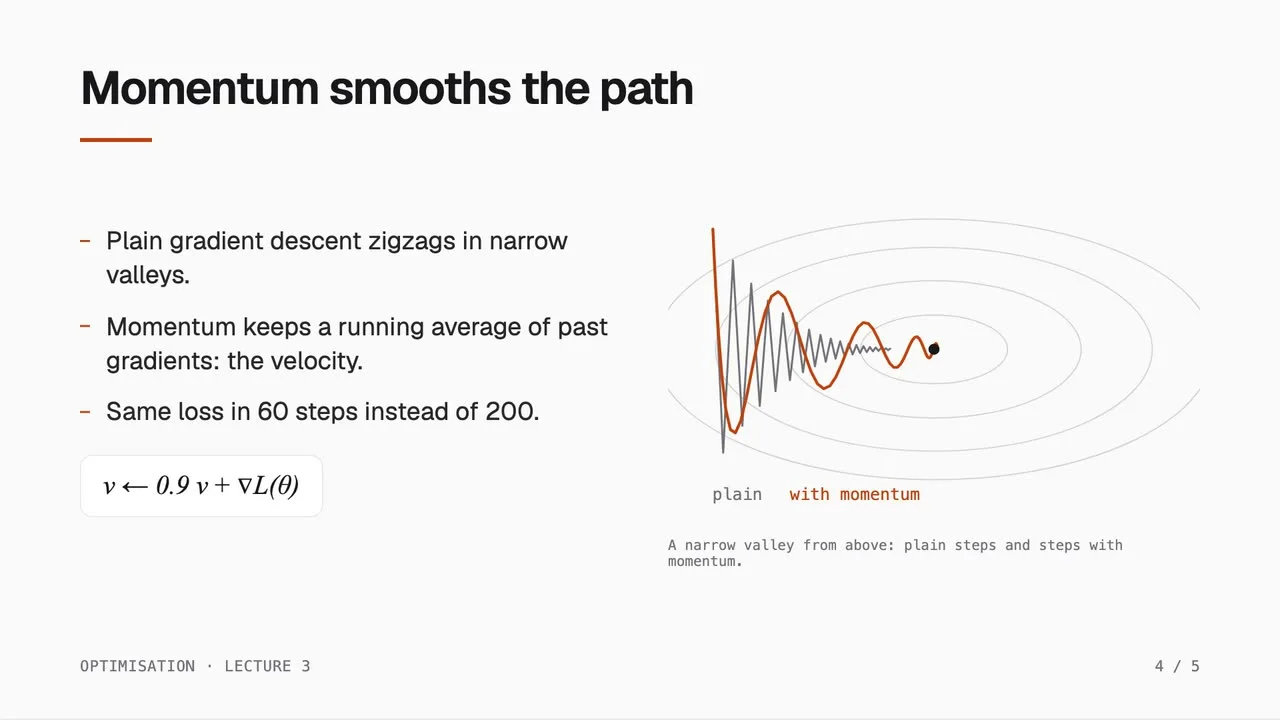
- Plain gradient descent zigzags in narrow valleys.
- Momentum fixes this by keeping a running average of past gradients, which we call the velocity.
- The update adds ninety percent of the previous velocity to the new gradient in the narrow valley.
- With momentum, the same loss was reached in sixty steps instead of two hundred.
1:31Summary and outlook
- Gradient descent follows the slope downhill.
- The learning rate controls the step size and must be neither too small nor too large.
- Momentum smooths the path and speeds up training.
- Next week the lecture will look at adaptive methods such as Adam.
The transcript: 15 sentences, each with its time
- 0:00Welcome to this short lecture on gradient descent. Today we will cover three things. What the method is?
- 0:06How the learning rate changes its behavior and why momentum helps.
- 0:11Let us start with the idea. We have a function that measures how wrong our model is.
- 0:16We call it the loss.
- 0:17Gradient descent looks at the slope of the loss at the current parameters and takes a small step downhill. We repeat this until the loss stops getting smaller. Each step uses the gradient, which is the vector of partial derivatives of the loss with respect to every parameter.
- 0:34Now the learning rate.
- 0:35The learning rate is the size of each step. If it is too small, training takes forever, because every step barely moves the parameters. If it is too large, the steps overshoot the bottom of the valley and the loss can even grow.
- 0:49A common starting value is zero point zero one, and people often reduce it by a factor of ten when the loss stops improving. In our experiment, a learning rate of zero point one diverged after twenty steps.
- 1:03While zero point zero one reached a loss of zero point three after two hundred steps.
- 1:08The third topic is momentum plane gradient descent zigzags in narrow valleys.
- 1:14Momentum fixes this by keeping a running average of past gradients.
- 1:18Which we call the velocity. The update adds ninety percent of the previous velocity to the new gradient in the narrow valley. Example, momentum reached the same loss in sixty steps instead of two hundred.
- 1:31To summarize.
- 1:32Gradient descent follows the slope downhill. The learning rate controls the step size and must be neither too small nor too large, and momentum smooths the path and speeds up training. Next week we will look at adaptive methods such as adam.
- 1:47Thank you for listening.